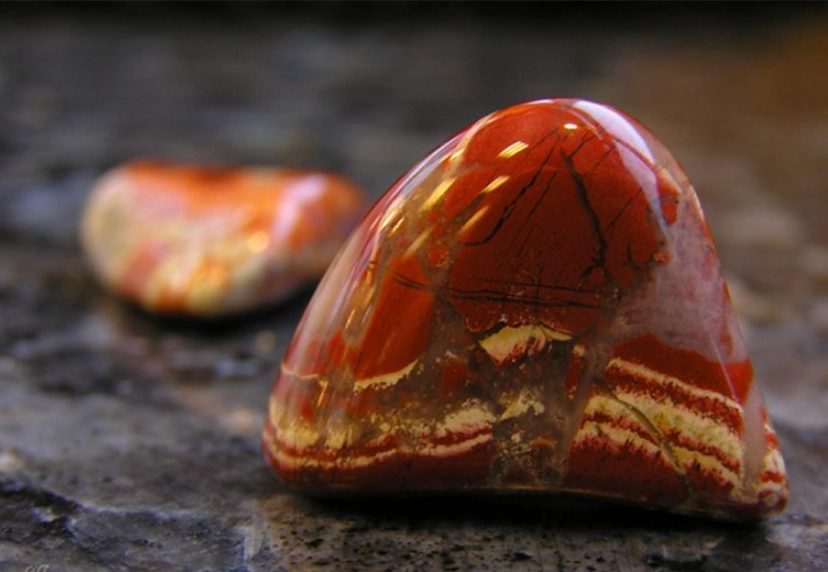
Jasper stone. Just the name brings to mind a kaleidoscope of colors and patterns, doesn't it? Earthy reds, deep ocean blues, vibrant yellows, and intricate banding that looks like a painting. For thousands of years, people have been picking up these stones, marveling at their beauty, and attributing all sorts of meanings to them. But here's the thing most beginner guides miss: not every patterned stone you find is jasper. In fact, the term 'jasper' itself is a bit of a catch-all in the gem trade. It's not a single mineral, but a microcrystalline variety of quartz. That means it's made of tiny, interlocking crystals you usually can't see with the naked eye. This structure is what gives jasper its incredible durability and allows it to take such a high polish. But it also means that what we call 'types of jasper stone' are often just trade names based on appearance and where they're found. Let's cut through the confusion and get real about identifying, choosing, and using the different types of jasper stone.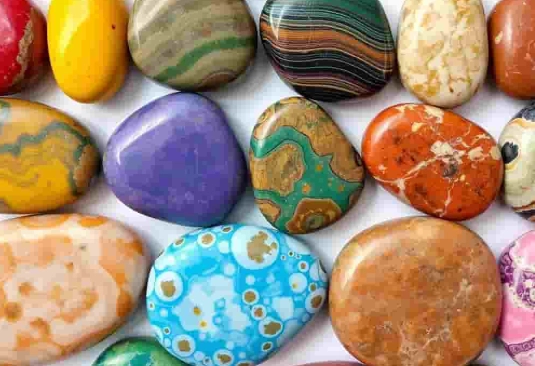
What You'll Discover In This Guide
I remember the first piece of jasper I bought. It was a small, polished red jasper worry stone from a local gem show. The vendor told me it was for 'courage and vitality.' Sounded good. But after a decade of collecting, appraising, and even making a few mistakes (like that expensive 'picture jasper' sphere that turned out to be dyed agate), I've learned that the real value lies in understanding the specifics. Let's get into it.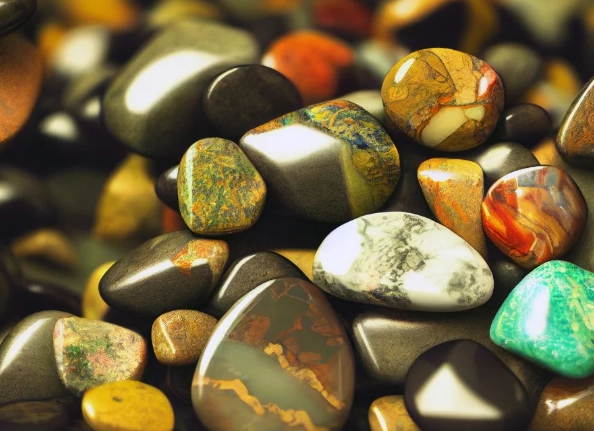
How to Identify Your Jasper Stone: Skip the Generic Advice
Most guides will tell you to look for patterns, color, and translucency. That's a start, but it's like telling someone to identify a bird by looking for feathers. It's technically correct but not very helpful. The single most overlooked detail is the nature of the pattern's edges. Are they sharp, distinct lines separating the colors (like in a banded jasper), or are they soft, feathery, gradual blends (like in an orbicular jasper)? This tells you more about how the stone formed than any color does. Sharp boundaries often indicate a clear change in mineral composition during formation, while soft blends suggest a slower, more gradual process. Beginners often mistake any red stone with white streaks for red jasper, but true red jasper's iron inclusions are almost always a specific, rusty orange-red, not a bright, cherry red.
Common Mistakes in Jasper Stone Identification
Here's a mistake I see all the time: people assume a stone labeled 'jasper' is solid all the way through. In reality, many larger decorative pieces are actually jasper-agate composites. The jasper forms the outer, opaque crust, while the agate (a more transparent, banded chalcedony) forms the inner core. They're both quartz, so it's not a 'fake,' but it does affect the energy work some folks talk about. If you're buying for decoration, it doesn't matter. If you're paying a premium for a 'pure jasper' specimen, check for concentric banding or a translucent center when you hold it up to a strong light. Again, not a deal-breaker, just something to be aware of.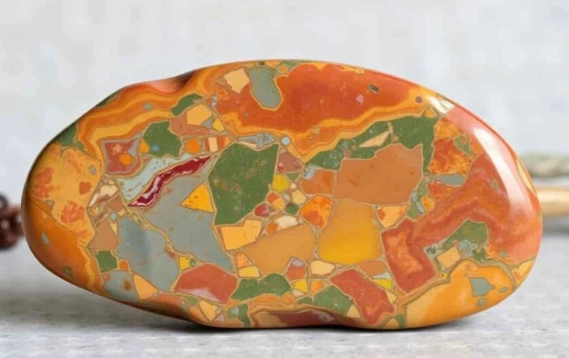
The 5 Major Pattern Categories (And What They Mean)
Patterns are where jasper gets interesting. They're not just random; they tell the story of the stone's formation. Here's a breakdown that most sellers won't tell you:
- Banded Jasper: This is the classic, layered look. It forms from sedimentary deposits under extreme pressure. The bands are different layers of mineral-rich sediment. The width and regularity of the bands can indicate how stable the environment was. Very fine, even bands often suggest a calm, slow deposition, while erratic, wavy bands point to turbulent water or shifting ground.
- Orbicular or Poppy Jasper: Those perfect little circles or 'poppy' patterns? They're formed from gas bubbles or volcanic ash pockets that get filled with different minerals, often chalcedony or opal. The rounder and more defined the circle, the more stable the bubble was. Imperfect, merged circles suggest the bubbles were close together or the material was still semi-liquid when they formed.
- Brecciated Jasper: This pattern shows broken fragments cemented together by a later mineral. It means the original jasper (or the host rock) fractured, likely from seismic activity or a landslide, and then a new solution seeped in to glue the pieces back together. It's a stone that tells a story of violence and repair.
- Dalmatian Jasper (or any spotted jasper): The spots are inclusions of a different mineral, often feldspar or clay. Their distribution is rarely truly random. A uniform spread suggests the inclusion material was evenly mixed in the silica gel before it hardened. A clustered distribution might mean the inclusions were added in pockets, or the stone has been tumbled in a way that concentrated them.
- Picture Jasper: This is the most 'figurative' and often misidentified. The key here is the contrast between the 'picture' and the background. True picture jasper has a sharp, distinct boundary. What many people call 'picture jasper' is actually just scenic patterns in any jasper. For a pattern to be considered a true 'picture,' it should resemble something recognizable without needing too much imagination. That's subjective, I know. But the market has over-corrected. Now, any jasper with a slight contrast gets labeled as 'picture jasper,' driving up prices for mediocre specimens.
Color Meanings: Beyond the Obvious
Sure, red is for passion and energy, blue is for calm, green is for growth. That's surface-level. Let's dig deeper. The color in jasper is almost entirely due to trace minerals and impurities. Iron gives us reds and yellows (red jasper, yellow jasper), manganese gives us blues and purples (blue jasper), and chlorite gives us greens (green jasper). But here's the non-consensus view I've developed after years of handling: the distribution of that color is more important than the shade itself. A uniform, solid red jasper speaks of a consistent environment rich in iron. A mottled, patchy red with white streaks (like in brick jasper) suggests the iron was not evenly distributed, perhaps due to flowing water or uneven pressure. This doesn't change the 'energy' of the stone, but it does tell a more accurate geological story. A uniform color is rare in nature. If you find a piece with a perfectly even color, it's more likely to have been treated or dyed. Natural stones have variations. Embrace them.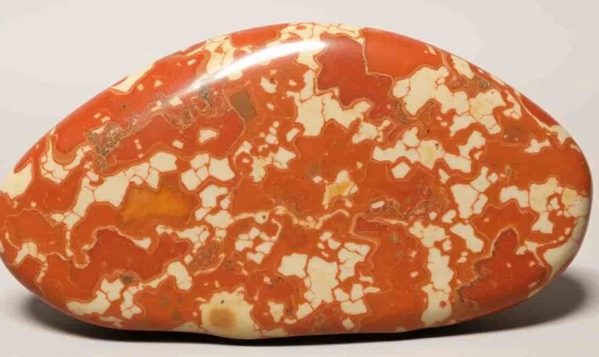
The 7 Most Popular Types of Jasper Stone You Need to Know
Let's get specific. These are the types you're most likely to encounter, whether online or in a shop. Knowing these will save you from overpaying for a common stone masquerading as something rare.
- Red Jasper: The classic. Iron oxide gives it that rich, brick-red color. It's dense, takes a great polish, and is found almost everywhere. The most common use is in worry stones and small tumbled stones for beginners because it's affordable and readily available. But here's the secret most sellers won't tell you: much of the 'red jasper' on the market is actually heat-treated agate or chalcedony dyed a deeper red. How to spot the real deal? Natural red jasper often has a slightly grainy texture and will show some color variation under a strong light. The dyed stuff looks too perfect, too uniform.
- Yellow Jasper: Also iron-based, but with a different oxidation state or mixed with other minerals like goethite. It ranges from pale lemon to deep mustard. It often contains patterns of browns and creams. A common mistake is confusing yellow jasper with golden-yellow citrine or even some types of agate. Yellow jasper is almost always opaque, not translucent.
- Green Jasper: This gets its color from chlorite or other green minerals like actinolite. It's one of the most sought-after colors. But here's the kicker: a deep, forest green is more common and often less valuable than a rare, apple-green or blue-green variety. Don't pay a premium for a dark green stone unless it has exceptional patterns.
- Brown Jasper (including picture jasper landscapes): Often underrated, brown jasper can contain some of the most intricate and scenic patterns, mimicking mountains, deserts, or forests. The brown color comes from various iron oxides and organic materials. The more detailed the 'picture,' the higher the price, but also the higher the chance it's been artificially enhanced. Look for natural transitions; if it looks like a photograph printed on stone, it probably is.
- Blue Jasper: Relatively rare. True blue jasper gets its color from manganese or specific mineral inclusions like azurite (which would make it more expensive). Most 'blue jasper' on the market is actually a grayish stone with a blue hue, or it's been dyed. A saturated, royal blue is very rare. If you find a piece that's cheap and intensely blue, question it.
- Dalmatian Jasper: This is the black stone with white or cream spots. The spots are usually kaolin or feldspar. It's named for its resemblance to the dog's coat. It's almost always opaque and takes a good polish. Its popularity in jewelry has made it widely available, but also means there are a lot of imitations. Real dalmatian jasper has spots that are distributed unevenly, like a natural animal's coat, not in a perfect polka-dot pattern.
- Leopard Skin Jasper: This is a trade name for a spotted, often orbicular pattern. It's not actually a different mineral; it's just a pattern name. The background color can vary (red, yellow, brown), but it always contains those distinctive, ring-shaped spots. It's a great stone for beginners because it's durable, affordable, and has a striking appearance.
Now, let's talk about the other major category: patterned jaspers. These are often more valuable than solid colors because of their uniqueness.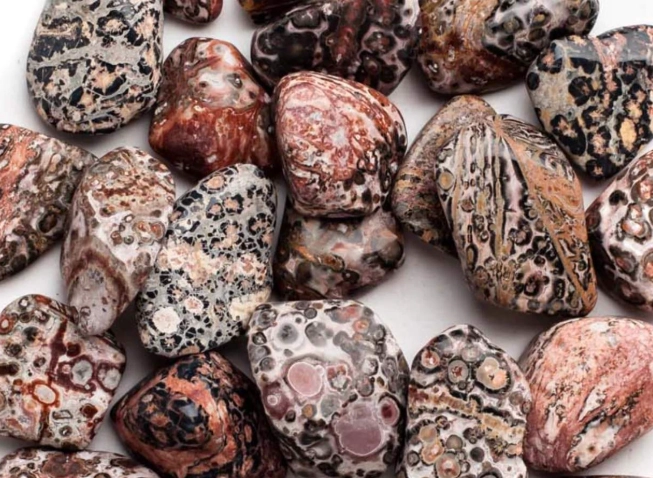
Patterned Jaspers: The Real Showstoppers
- Picture Jasper: This is the one everyone wants. It shows scenic patterns that look like landscapes, deserts, or forests. The key to a valuable piece is not just the clarity of the 'picture,' but the depth and contrast. A two-dimensional, flat 'picture' is less desirable than one that has a sense of depth and perspective, even if the image itself is more abstract.
- Banded Jasper (like Bruny Island Jasper): Sharp, parallel lines of different colors. This indicates a very stable, layered deposition environment. The more parallel and distinct the bands, the higher the quality.
- Orbicular Jasper (like Ocean Jasper): Those perfect, concentric circles. They form around a nucleus, often a fossil or a gas bubble. The size, regularity, and color of the rings determine the value. Perfect circles are rare; most are slightly irregular, which is a sign of natural formation.
- Brecciated Jasper: A personal favorite of mine. It's a broken and reassembled stone. The fragments can be of the same material or different ones, held together by a later mineral. It tells a story of fracture and healing. A good brecciated jasper shows clear, angular fragments with a contrasting cementing material. If the fragments are all the same color and the cement is barely visible, it's less interesting.
The 7 Most Popular Types of Jasper Stone
Now, let's look at some specific, named varieties you'll often see for sale. This table should help you navigate the market:
| Name | Primary Colors & Patterns | Common Sources (and what that means for price) | What It's Often Used For |
|---|---|---|---|
| Red Jasper | Solid brick-red to deep red with possible white/black patterns | Worldwide (Brazil, India, Russia). Brazil often produces the deep, uniform reds. | Worry stones, tumble stones, beads, cabochons. The most common and affordable. |
| Yellow Jasper | Lemon yellow to mustard, often with brown patterns | Madagascar, Mexico, USA. Madagascar is famous for its vibrant yellow picture jaspers. | Similar to red jasper, but often slightly more expensive due to less common large deposits. |
| Green Jasper | Forest green to apple green, often with dark patterns or inclusions | South Africa, Australia, USA. The deep, forest green from South Africa is highly prized. | Carved animals, spheres, decorative boxes. Often commands a premium, especially for larger, pattern-free pieces. |
| Brown Jasper (Landscape/Picture) | All shades of brown, creating 'landscape' patterns | USA (Oregon, Idaho), Morocco. Oregon is the king of landscape jasper, producing the most sought-after scenes. | Slabs, bookends, large decorative pieces. The pattern dictates the price more than the color. |
| Blue Jasper | Grayish-blue to a rare, royal blue | Namibia, Madagascar, USA. A true, saturated blue is very rare and expensive. | High-end jewelry, collector's specimens. Often the most expensive per carat. |
| Dalmatian Jasper | Black with white/cream spots | Mexico (the main source). Uniform, well-defined spots are key. | Beads, small carvings, worry stones. Popular for its striking contrast. |
| Leopard Skin Jasper | Spotted patterns in yellow, red, or brown backgrounds | Africa, USA, Brazil. The name refers to the pattern, not a source. | Spheres, palm stones, small carvings. Popular for its unique patterns. |
| Rainbow Jasper | Multi-colored, often with iridescent bands | Australia, Mexico. More a trade name for any jasper with multiple colors. | Polished slabs, spheres. The iridescence can fade if not properly cared for (avoid prolonged direct sunlight). |
I have a piece of Madagascar picture jasper on my desk that looks like a rolling savanna at sunset. I paid a bit more for it because the scene had depth. But I've also bought cheap pieces online that looked great in pictures but were flat and uninteresting in person. The lesson? Always, always try to see the actual stone before purchasing, especially online. A video under natural light is better than a dozen photoshopped images.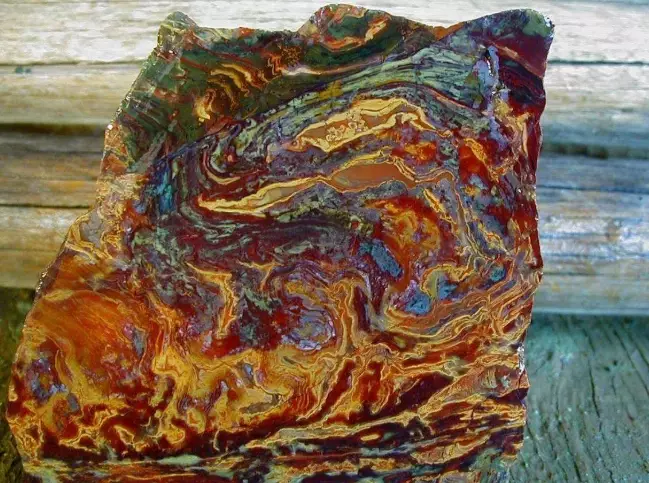
Rare & Collectible: Hidden Gems You Might Own
Now we venture into the territory of rare jaspers. These are the types that collectors and enthusiasts geek out over. They're often named after their specific locations, and the location can drastically affect the value.
- Imperial Jasper: This isn't a type of jasper; it's a trade name for a high-quality, often greenish jasper with intricate patterns that was historically used in Imperial Chinese carvings. It's rare and expensive. Most of what's sold as 'Imperial Jasper' today is just high-grade picture jasper from various locations.
- Mookaite Jasper: From Western Australia, this is actually a fossiliferous sedimentary rock, not a pure jasper. It contains fossilized radiolarians (tiny sea creatures) that give it a unique, cellular pattern. It comes in stunning reds, yellows, and browns. Because it's from a single, remote location and is technically a fossil, it's highly collectible and can be expensive.
- Biggs Jasper: From Oregon, USA, this is a famous picture jasper known for its scenic patterns. It's often cut into slabs and spheres to showcase the 'paintings' nature created. Prices can vary wildly based on the clarity and detail of the scene.
- Bumblebee Jasper: This isn't a jasper at all. It's actually a calcite with arsenic and sulfur inclusions, making it yellow and black banded. It's toxic in its raw form and should only be handled when polished and sealed. It's included here because the name is misleading, and you should be aware of what you're actually buying.
Here's a controversial opinion: the rarity and value of a jasper are not always determined by how pretty it is. Sometimes, a less aesthetically pleasing stone from a famous locality (like a specific mine in Oregon) can be worth more to a collector than a flawless, beautiful piece from an unknown source. It's about the story and the origin.
Practical Jasper Stone Care & Identification
So you've got a piece of jasper, or you're thinking of buying one. How do you take care of it? And how do you know you're not getting ripped off?
How to Cleanse and Care for Your Jasper Stone
Forget the full moonlight and sage smudging rituals you read about on every other site. They're fine if you're into that, but they're not necessary. Jasper is a tough stone. It's harder than glass and most metals you'll encounter in daily life. The main things to avoid are:
- Extreme heat: Don't leave it in a hot car or on a windowsill in direct, blazing sunlight for weeks on end. Thermal shock can cause fractures, and prolonged intense UV light can potentially fade some colors over years, though this is debated.
- Harsh chemicals: Avoid soaking it in bleach, sulfuric acid, or other strong cleaning agents. A quick dip won't ruin it, but prolonged exposure isn't good for any stone.
- Ultrasonic cleaners: These are generally safe for most solid jasper pieces, but if your stone has fractures or is part of a delicate setting with other stones, it's better to avoid the risk. Stick to warm, soapy water and a soft brush.
For cleansing, I'm a proponent of the simplest method: running water. Hold your jasper under lukewarm running water for a minute. Visualize any negativity or stagnant energy washing away. Dry it with a soft cloth. That's it. It's a physical and symbolic reset that requires no special tools. I find this more effective than any elaborate ritual because it's tangible.
How to Identify Real Jasper vs. Fake or Imitation
This is where a bit of knowledge saves you money. Because jasper is so common and popular, it's often imitated. The most common imitators are:
- Plastic or resin: These feel warm to the touch, not cool like stone. They're also much lighter. Do a simple scratch test with a steel knife (not your good kitchen knife!). Real jasper will not scratch from a knife; plastic will.
- Glass: Glass is smoother, often has air bubbles or swirls inside it, and feels different. It's also usually colder to the touch than plastic but can be similar to stone. The key here is the pattern. Natural patterns in jasper are never perfectly repeated. If you see two sections that are mirror images of each other, it's likely manufactured.
- Dyed howlite or magnesite: These are softer stones often dyed to imitate red or green jasper. They have a different texture, often more chalky or porous, and the color will be concentrated in cracks or veins, not consistent throughout.
The best tool you have is your own observation. Look for natural variations in color and pattern. Feel the weight. Learn the specific characteristics of the type of jasper you're interested in. And when in doubt, ask the vendor for a hardness test or where they sourced it. A reputable seller won't mind.
How to Choose the Right Jasper Stone for You
This is the most important part. Forget the generic 'this stone is for courage' advice. Choosing a jasper stone is a personal and visual process. Ask yourself:
- What color am I drawn to right now? Don't force yourself to choose a 'powerful red' if you're feeling overwhelmed and need calm. A blue or green stone might be better.
- What pattern speaks to me? Do I like defined, sharp patterns (banded, brecciated), or soft, gentle blends (orbicular, picture)?
- What size and shape do I want to carry or wear? A large palm stone is great for meditation at home, but a small, tumbled stone is better for carrying in your pocket.
Let me give you a personal example. I used to carry a piece of red jasper in my pocket every day when I was starting a new job. I thought it was giving me energy. Maybe it was, maybe it wasn't. But I lost it one day, and you know what? Nothing changed. The ritual of reaching into my pocket and feeling the smooth stone was what was calming, not the stone itself. Now, I choose stones based on what I find beautiful that day. Sometimes it's a rough, uncut piece that fits perfectly in my hand. Other times it's a polished sphere that catches the light on my desk. The point is, the connection you form with the stone is more important than any prescribed meaning.
Your Jasper Stone Questions, Answered
Let's tackle some specific questions that come up time and again in my workshops and when people send me photos for identification.
Related Articles
Unlocking the Spiritual Meaning of Tigers Eye: A Complete Guide
Larimar Stone Meaning and Uses: The Ultimate Guide to the Atlantis Stone
Larimar Stone: The Complete Guide to the Caribbean Gem of Serenity
Blue Aventurine Meaning: Healing Properties, Uses & Benefits
Blue Chalcedony: Unveiling Its Other Name & Gemstone Secrets