In This Guide
- What is Indigo Gabbro, Really? A Rock by Any Other Name
- Breaking Down the Indigo Gabbro Composition: The Mineral Cast
- How Did This Crazy Rock Form? The Geological Story
- Physical Properties: The Feel and Heft of Indigo Gabbro
- How to Spot the Real Deal vs. a Fake or Lookalike
- The Metaphysical Angle: Separating Folklore from Geology
- Common Questions About Indigo Gabbro Composition & Care
- Final Thoughts: Appreciating the Rock for What It Is
Let's be honest, when you first pick up a piece of Indigo Gabbro, it's hard not to be captivated. That deep, cosmic blue mixed with swirling whites and blacks – it looks like a piece of a starry night sky or a distant nebula frozen in stone. But what exactly is it? The name gets thrown around in crystal shops and online stores, often with more focus on its supposed metaphysical properties than its actual geological makeup. I think that's a shame. Knowing the real Indigo Gabbro composition makes owning or collecting it so much more meaningful. It's the difference between just having a pretty rock and understanding a tiny piece of our planet's incredible story.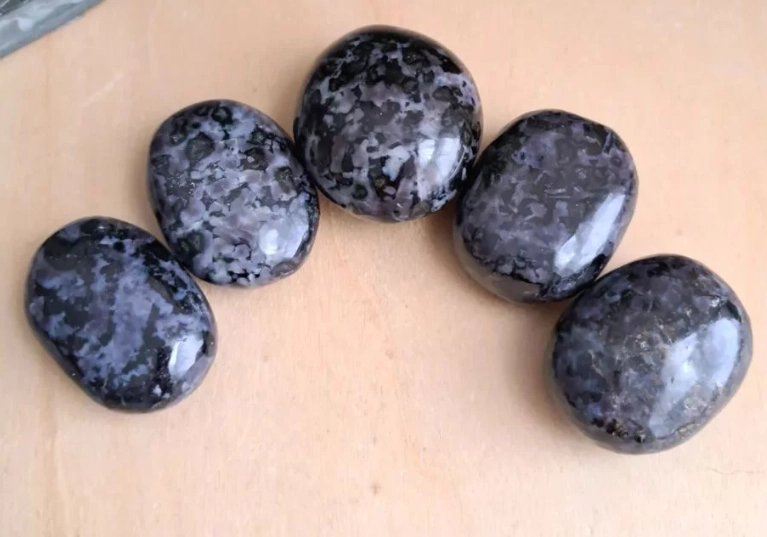
So, we're going to strip away the mystery and get down to the gritty, grainy, scientific truth. What minerals is it made of? Where does that stunning color actually come from? And how can you tell if what you have is the real deal? We're diving deep, and I promise, the real story is more fascinating than any vague spiritual description.
The Core Truth: Indigo Gabbro is not a single mineral. It's an igneous rock, which means it formed from cooled magma. Its composition is a complex, interlocking mixture of several key minerals. The magic—and the challenge in identifying it—lies in the specific blend and texture of those components.
What is Indigo Gabbro, Really? A Rock by Any Other Name
First things first, let's clear up the name game. In the world of geology, names have strict rules. "Gabbro" refers to a specific family of coarse-grained, dark, intrusive igneous rocks. True gabbro is primarily composed of plagioclase feldspar and pyroxene. Now, here's where it gets tricky for our star rock. The classic Indigo Gabbro composition often cited includes minerals that aren't typical for standard gabbro, like orthoclase feldspar and quartz.
This has led to some debate. Is it a true gabbro, or is it closer to a diorite or even a monzonite? Frankly, from a strict geological classification standpoint, much of what's sold as Indigo Gabbro might be more accurately called a "gabbroic rock" or a specific variety. But in the lapidary and metaphysical market, the name "Indigo Gabbro" (and its catchy alias, "Blizzard Stone") has stuck like glue.
I remember getting my first piece years ago from a reputable dealer who insisted it was a type of gabbro. When I later looked at a thin section under magnification (a geologist friend helped me out), the mineralogy was more varied than I expected. It was a lightbulb moment. The trade name simplifies a complex reality. For our purposes, we'll use the commonly accepted term "Indigo Gabbro," but we'll define it by its actual, observable Indigo Gabbro mineral composition, not just by a textbook category it might not perfectly fit.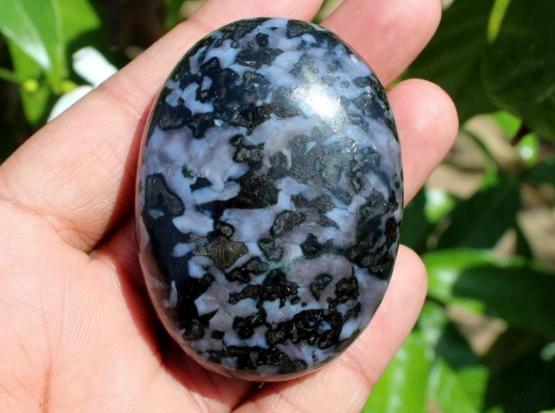
Its only known commercial source is Madagascar, which adds to its unique character. You won't find this exact blend just anywhere.
Breaking Down the Indigo Gabbro Composition: The Mineral Cast
This is the heart of the matter. Think of the rock as a mosaic. Each mineral is a differently colored and shaped tile. The overall picture—the color, the pattern, the feel—depends on which tiles are used and how they're arranged. Here’s the definitive list of the primary minerals that make up the composition of Indigo Gabbro.
The Essential Minerals in the Mix
These are the non-negotiable players. You'll find these in every genuine piece, though their proportions can vary wildly from one specimen to another, which is why no two pieces look exactly alike.
Plagioclase Feldspar (The White/Silver Star)
This is the source of the brilliant white, silver, or sometimes light gray flashes and crystals. Plagioclase is a series of minerals ranging from calcium-rich to sodium-rich. In Indigo Gabbro, it tends to be the more sodium-rich variety (albite or oligoclase). It forms the chunky, blocky, often rectangular crystals that catch the light. When you see a sharp, geometric white crystal shining back at you, that's almost certainly plagioclase. It's a major contributor to the "blizzard" effect, like snowflakes suspended in a dark sky.
Orthoclase Feldspar (The Potential Color Shifter)
Here's a key component that often gets overlooked. Orthoclase is a potassium-rich feldspar. It's often present in smaller amounts than plagioclase but is crucial. Pure orthoclase is typically flesh-colored or pinkish. Some experts believe that trace elements within the orthoclase (like iron in a specific state) might interact with light to contribute to the blue hues, especially in certain lighting. Its presence is one of the factors that blurs the line between a true gabbro and other rock types.
Quartz (The Glassy Intruder)
The presence of quartz is another big clue that this isn't a classic gabbro. Standard gabbro is usually quartz-free. But in Indigo Gabbro composition, you can often find small amounts of quartz filling in the spaces between the larger feldspar and amphibole crystals. It appears as clear, glassy, or smoky gray patches. It doesn't dominate the look, but it's a vital signpost for identification.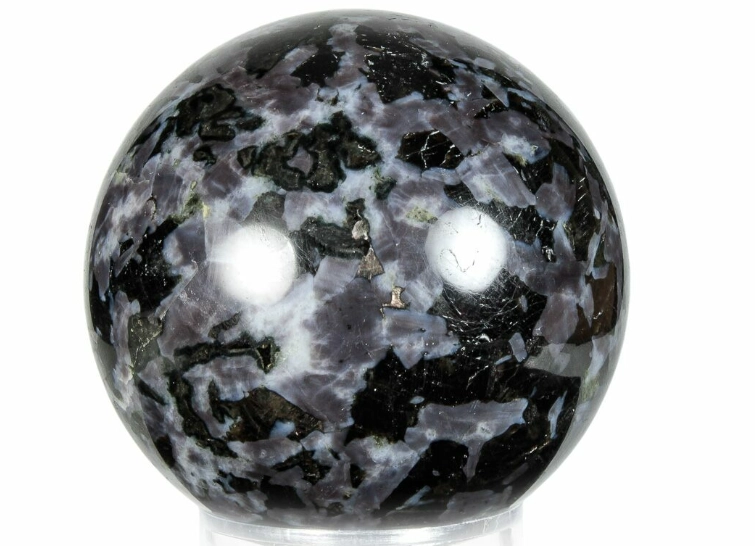
The Blue Maker: Amphibole (Specifically, Hornblende)
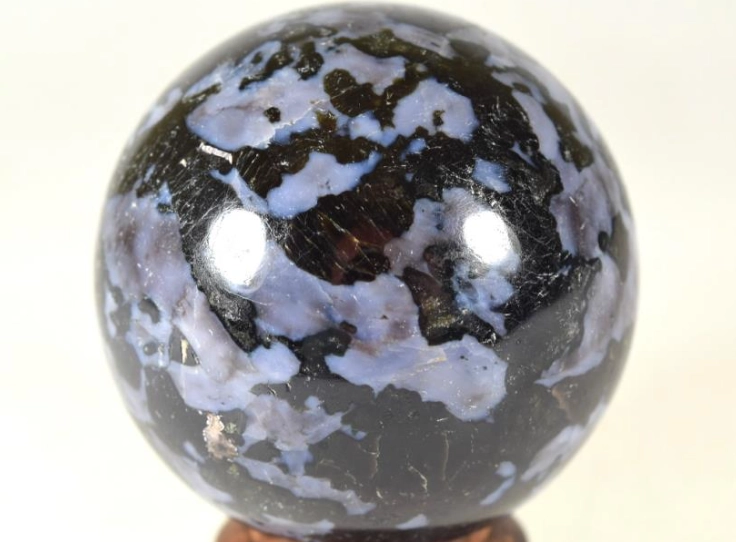
This is the superstar. The deep blue, indigo, and black colors are almost entirely due to minerals from the amphibole group, with hornblende being the most common culprit. Hornblende is a complex silicate that can contain iron, magnesium, aluminum, and other elements. In massive, dark form, it looks black. But when it forms in elongated, prismatic crystals (which it often does in this rock), light interacts with its internal crystalline structure in a way that can produce strong pleochroism—meaning it shows different colors when viewed from different angles. This is the secret.
You might look at one angle and see inky black. Tilt it under a light, and suddenly a flash of deep, royal blue or violet-blue appears along the length of the crystal. The overall indigo impression comes from a combination of these dark amphibole crystals and the way light scatters through the rock matrix. It's not a pigment; it's a light trick played by crystal physics. Without quality amphibole crystals, you just have a black and white rock.
Supporting Cast: Biotite and Others
You'll often see flecks of black mica, specifically biotite. It forms shiny, flaky sheets that can add a subtle sparkle. In some specimens, you might also find tiny amounts of magnetite (a black, magnetic iron oxide) or ilmenite. These accessory minerals add to the density and the complex visual texture.
| Mineral | Primary Color in Indigo Gabbro | Role in Composition | Key Identifying Feature |
|---|---|---|---|
| Plagioclase Feldspar | White, Silver, Light Gray | Primary felsic mineral; creates the "snow" or bright specks. | Blocky, rectangular crystals with a pearly or glassy luster. |
| Amphibole (Hornblende) | Black with Blue/Violet Pleochroism | Primary mafic mineral; source of the iconic indigo color. | Long, prismatic crystals that flash blue when tilted in light. |
| Orthoclase Feldspar | Off-White, Flesh, Pinkish Tinge | Adds to feldspar content; may influence color chemistry. | Often intergrown with plagioclase, less perfect crystal shapes. |
| Quartz | Clear, Smoky Gray, Glassy | Fills interstices; indicates a more silica-rich melt. | No cleavage, conchoidal fracture, greasy or vitreous luster. |
| Biotite Mica | Black, Shiny | Accessory mineral; adds sparkle and flaky texture. | Perfect cleavage into thin, flexible, shiny sheets. |
How Did This Crazy Rock Form? The Geological Story
Understanding the Indigo Gabbro composition isn't just about listing minerals. It's about telling the story of how they all got together. This rock was born from a magma chamber deep underground, cooling slowly over thousands or millions of years. That slow cooling is why the crystals are big enough to see with the naked eye (a texture called "phaneritic").
But the special blend—the fact that it has both the dark, iron/magnesium-rich minerals (amphibole, biotite) and the light, silica-rich minerals (both feldspars, quartz)—tells us the parent magma was likely intermediate in composition. It wasn't a pure basalt melt (which would make a true gabbro) and it wasn't a pure granite melt. It was something in-between, perhaps contaminated by crustal rocks it passed through. This hybrid origin story explains the unique and sometimes controversial Indigo Gabbro mineral composition.
The magma likely underwent a process called fractional crystallization. As it cooled, different minerals crystallized out at different temperatures. The amphiboles and early feldspars formed first. The leftover melt became enriched in silica and other elements, allowing quartz and orthoclase to form later, filling in the gaps. That's why you often see quartz nestled between the bigger, earlier-formed crystals.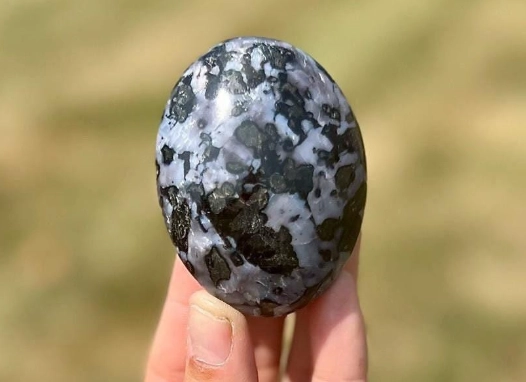
Physical Properties: The Feel and Heft of Indigo Gabbro
You can learn a lot about the composition of Indigo Gabbro just by handling it. Its physical properties are a direct result of the minerals we just talked about.
- Hardness: It's a tough rock. On the Mohs scale, it sits around 6 to 6.5. Why? Because quartz is hardness 7, feldspar is around 6, and amphibole is 5-6. A steel file (hardness ~6.5) will just barely scratch it, if at all. This makes it decent for jewelry, though it can still be scratched by harder materials like quartz or topaz.
- Density & Feel: It feels heavy for its size. That's the high iron content in the amphibole and any accessory magnetite. It has a substantial, cold heft in your hand that cheaper, dyed imitations can't replicate.
- Fracture & Cleavage: It doesn't have a consistent cleavage like mica. It tends to break in a conchoidal (shell-like) or irregular pattern, which is influenced by the interlocking grains of the different minerals. If you try to break a chunk (not recommended for a nice specimen!), it would be tough and would not split neatly along a plane.
- Luster: This is a mix. The feldspars can be pearly or vitreous (glassy). The amphibole crystals can have a vitreous to somewhat silky luster. The biotite is brilliantly shiny. Overall, a polished piece has a beautiful, complex vitreous to sub-vitreous luster.
How to Spot the Real Deal vs. a Fake or Lookalike
This is where understanding Indigo Gabbro composition becomes practical. The market is flooded with lookalikes, dyed stones, and outright fakes. Here’s how to use your new knowledge to be a savvy buyer.
Top Signs of Genuine Indigo Gabbro
- The Blue is Elusive: The indigo color is not a flat, even paint job. It's a flash, a sheen, a deep glow that appears on the edges of black crystals when you rotate it in good light. If it's uniformly, brightly blue all over, be suspicious.
- The White is Crystalline: The white parts aren't a chalky paste. They should look like broken, angular crystals (feldspar). Under a 10x loupe, you should see crystalline structure, not bubbles or a uniform texture.
- The Weight Test: It should feel dense. Compare it to a similarly sized piece of agate or quartz; the Indigo Gabbro should feel noticeably heavier.
- Complexity, Not Simplicity: The pattern is chaotic and intergrown—a true "blizzard." It's not neat layers or uniform speckles. You can get lost looking at the details.
Common Fakes and How to Avoid Them
Dyed Howlite or Magnesite: This is the most common imposter. Howlite is naturally white with gray webbing. Dye settles in the porous areas, creating a stark, unnatural blue-and-white pattern. The blue is often too bright (like a highlighter), sits on the surface, and may rub off on a cotton swab with acetone. Howlite is also much softer (around 3.5 on Mohs) and feels lighter.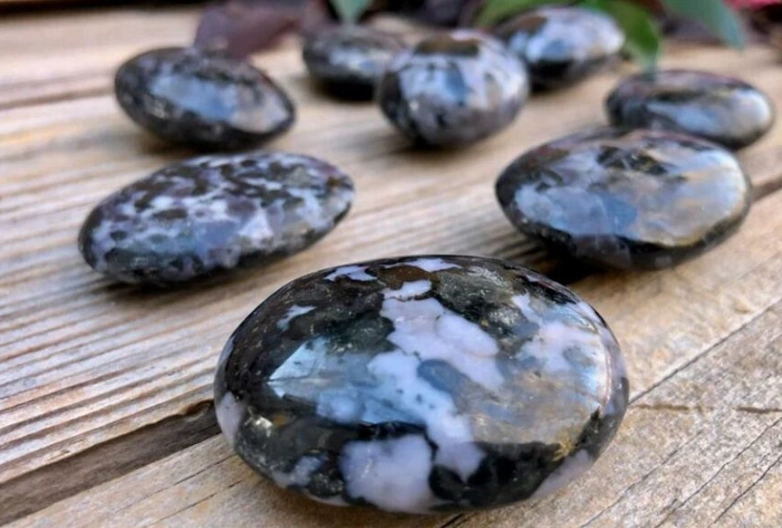
Glass or Resin Composites: These feel all wrong. They're lighter, warmer to the touch, and often have a plastic-y shine. Look for mold seams, air bubbles trapped inside, or a too-perfect, flow-like pattern. The "crystals" will have no real internal structure.
Other Natural Rocks: Sometimes larvikite or other dark rocks with feldspar flashes are mislabeled. Larvikite has a beautiful silver-blue schiller (labradorescence) from plagioclase, but it's a uniform flash across flat crystal faces, not the deep, prismatic blue-on-black of amphibole in Indigo Gabbro.
The Metaphysical Angle: Separating Folklore from Geology
Alright, let's address the elephant in the room. Indigo Gabbro is hugely popular in crystal healing circles, where it's called a powerful "stone of revelation" or "multidimensional stone." Proponents claim it connects the crown chakra, enhances psychic abilities, and helps with dream work.
Here's my take, grounded in the Indigo Gabbro composition: There is zero scientific evidence that any rock can manipulate biological energy fields, chakras, or psychic powers. These are cultural and spiritual beliefs, not geological properties. The minerals in it—quartz, feldspar, amphibole—are common in countless other rocks and have no unique electromagnetic or radioactive signature that would support these claims.
However, the psychological effect is very real. Its profound beauty can be a focus for meditation. The act of holding a cool, heavy piece of ancient Earth can be grounding. The complexity of its pattern can stimulate wonder and a sense of connection to nature. If using it as a meditation aid or a meaningful object brings you peace or focus, that's a valid and personal benefit—it just comes from your mind, not from the rock's mineral composition emitting special waves.
I think the metaphysical marketing, while often divorced from science, does point to one true thing: people are instinctively drawn to its incredible visual depth. That reaction is genuine, even if the explanations sometimes aren't.
Common Questions About Indigo Gabbro Composition & Care
Final Thoughts: Appreciating the Rock for What It Is
After all this, I hope you see Indigo Gabbro with new eyes. Its value isn't in unproven energies, but in its tangible, incredible reality as a geological artifact. The Indigo Gabbro composition—a specific, fortuitous blend of feldspars, amphibole, and quartz—created under unique conditions in Madagascar, is what gives it that unparalleled beauty.
When you hold a piece, you're holding a snapshot of a cooling magma chamber from deep time. The blue flash is a lesson in optics and crystal structure. The heavy weight speaks of iron and deep-Earth processes. That's more magical to me than any generic healing claim.
So, whether you're a collector, a jeweler, or just someone who loves beautiful things, understanding its true makeup is the key to truly valuing it. It allows you to identify quality, avoid scams, and, most importantly, connect with a genuine wonder of the natural world. Now go take a look at your own piece—see if you can spot the plagioclase crystals and hunt for that elusive blue flash in the amphibole. The story is right there in the stone.
Related Articles
Pink Quartz: Complete Guide to Meanings, Uses & How to Tell It Apart
Garnet Crystal: Meanings, Uses & How to Spot Real vs Fake
Red Jasper Meaning: Ultimate Guide to Healing Properties & Uses

Samsung Semiconductor, continue to fight to the death!

Indomitable IGBT!