Explore This Guide
- What Exactly Is Kyanite? The Science Behind the Sparkle
- Why People Are Drawn to Kyanite: Metaphysical and Healing Perspectives
- The Other Life of Kyanite: Industrial and Practical Uses
- How to Buy Kyanite: A No-Nonsense Guide for Collectors and Users
- Caring for Your Kyanite Crystal
- Kyanite Q&A: Answering Your Real Questions
- Final Thoughts: The Stone of Alignment
Let's talk about kyanite. You've probably seen it—those stunning blades of silky blue in crystal shops, sometimes looking almost too perfect to be real. I remember the first time I held a piece. It felt cold, smoother than glass, and had this strange, directional grain to it. I wasn't even sure what I was looking at. Was it a gem? A mineral for industry? Something for meditation? Turns out, it's all of the above, and that's what makes kyanite crystal so fascinating. It lives a double, even triple life.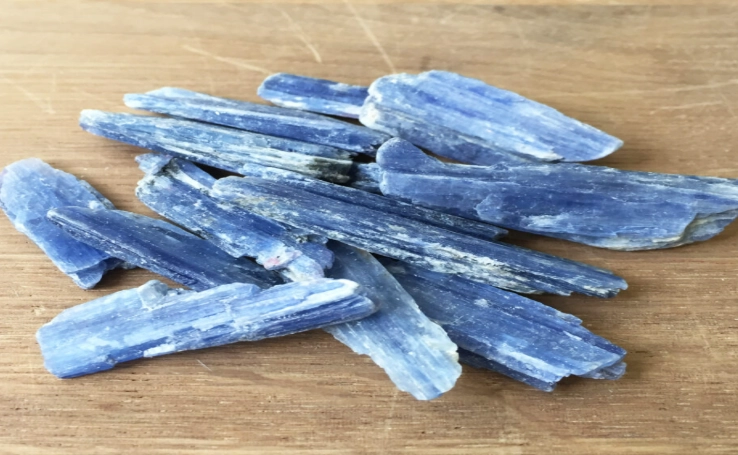
Most blogs will just tell you it's good for communication and throat chakras. Honestly, that's selling it short. There's a whole geological story and a range of practical uses that most spiritual guides completely ignore. So, whether you're a rockhound, a jewelry lover, or someone exploring crystal healing, stick around. We're going to get into the weeds on this one, from how it forms deep in the earth to why it might be sitting in your car's spark plug.
Here's the thing about kyanite: its identity crisis is its superpower. To a geologist, it's an index mineral that tells the story of metamorphic pressure. To an engineer, it's a refractory material that withstands insane heat. To someone on a spiritual path, it's a calming, aligning stone that doesn't need cleansing. How many other crystals can claim that kind of resume?
What Exactly Is Kyanite? The Science Behind the Sparkle
Kyanite is a silicate mineral, aluminum silicate to be precise (Al₂SiO₅). It forms under high-pressure conditions during the metamorphism of aluminum-rich rocks like shale. Think of the colossal forces where tectonic plates collide—that's kyanite's birthplace. You won't find it forming near a volcano; it's a child of deep, crushing pressure and moderate temperatures.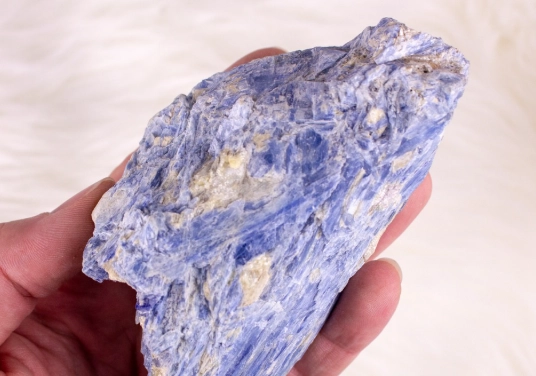
The most mind-blowing property, and the source of its name, is its anisotropy. "Kyanite" comes from the Greek word 'kyanos,' meaning blue, but the mineralogists who named it were probably more struck by its physical weirdness. It has two distinct hardnesses on the Mohs scale. Scratch it along the long axis of the crystal, and it's around 4.5 to 5. Scratch it across the blade, and it jumps to 6.5 to 7. Try it yourself (gently, on a sample you don't mind scratching). It's a fantastic identifier. This happens because of the way its atomic bonds are arranged—stronger in one direction than the other.
Quick Geology Fact: Kyanite is part of a trimorphous trio with andalusite and sillimanite. All three have the exact same chemical formula (Al₂SiO₅) but different crystal structures formed under different pressure/temperature conditions. Kyanite is the high-pressure, moderate-temperature member. You can dive into the detailed phase diagrams on Mindat.org's kyanite page, a fantastic resource for mineral data.
Its classic color is that beautiful cornflower to sapphire blue, caused by traces of iron. But here's where it gets colorful.
The Rainbow in the Rock: Kyanite's Color Varieties
Blue gets all the attention, but kyanite crystal comes in a surprising palette. The color depends on impurities present during formation.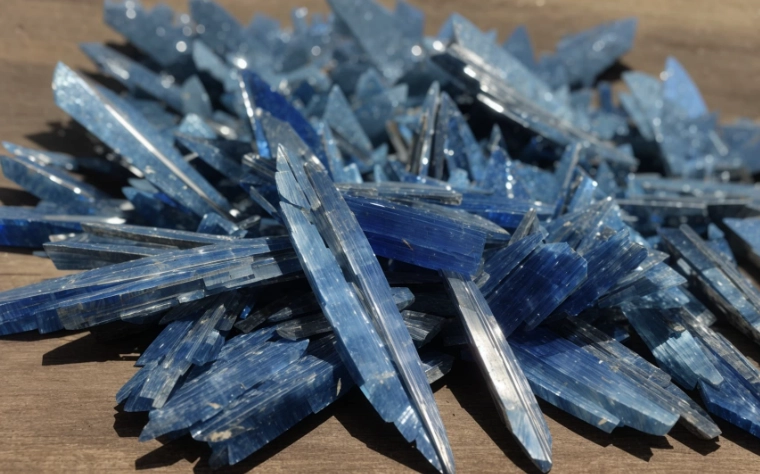
| Color Variety | Cause/Impurity | Where It's Found | Notes & Appeal |
|---|---|---|---|
| Blue Kyanite | Iron (Fe) | Nepal, Brazil, USA (NC, GA), Austria, Switzerland | The classic. Ranges from pale to deep blue, often in bladed aggregates. The most sought-after for spiritual work. |
| Orange Kyanite | Manganese (Mn) | Tanzania (main source), Nepal | Also called "Manganokyanite." Vibrant orange to reddish blades. A relatively recent and popular find in the crystal market. |
| Green Kyanite | Chromium (Cr) or Vanadium (V) | Kenya, Tanzania, Nepal | Often a softer, sage green. Can be translucent. Connects heart chakra energies with kyanite's aligning properties. |
| Black Kyanite | Inclusions of graphite or other minerals | Brazil, USA | Forms in radiating, brittle blades or fans. Has a very grounding, protective feel compared to the ethereal blue. |
| Colorless/White Kyanite | Pure aluminum silicate | Various locations | Rare. A collector's piece. Represents the pure, uncolored form of the mineral's energy. |
I have a small piece of the orange variety from Tanzania on my desk. It doesn't look like the blue kyanite at all at first glance—it's more vitreous, almost gemmy. But the tell-tale bladed structure is there. It's a great reminder that minerals aren't just one-note.
A vendor once tried to sell me a piece of bright blue, perfectly clustered kyanite at a price that seemed too good to be true. It was. It was reconstituted—basically, crushed kyanite mixed with resin and molded. It felt warm to the touch (real kyanite feels cool), had no directional hardness, and the color was uniform in a way natural stone rarely is. Lesson learned: if it looks flawless and cheap, be suspicious.
Why People Are Drawn to Kyanite: Metaphysical and Healing Perspectives
Alright, let's address the elephant in the room. The spiritual and healing uses of kyanite crystal are why most people search for it online. I'm not here to make wild medical claims—that's irresponsible. But I can tell you, from talking to countless practitioners and reading widely, what the established beliefs and reported experiences are. This stuff is part of its cultural footprint, like it or not.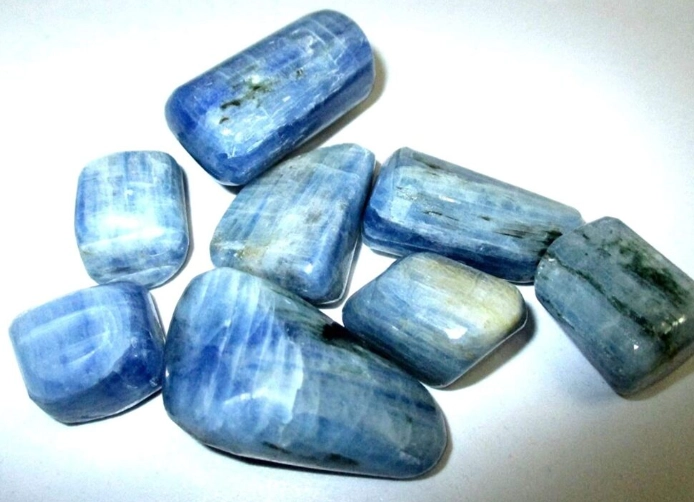
The core theme for blue kyanite is alignment and communication. It's said to be a stone that doesn't hold onto negative energy, so it never needs cleansing or charging under the moon or with sage. That alone makes it a low-maintenance favorite. People use it to:
- Meditate: Placed on the throat or third eye chakra to quiet mental chatter and facilitate clearer inner guidance.
- Energy Work: Its linear structure is believed to help straighten out energy pathways (meridians, aura streams). Some Reiki masters use wand-like pieces for this.
- Communication: Carried or worn when one needs to speak honestly, calmly, and effectively—before a presentation, a difficult conversation, or creative work.
- Dream Work: Placed under a pillow to encourage lucid dreaming or recall.
But what about the other colors? The meanings often branch out. Green kyanite is tied to heart healing, blending emotional balance with kyanite's aligning force. Orange kyanite is linked to creativity and sacral energy. Black kyanite is seen as powerfully grounding and protective, almost like a psychic lightning rod that disperses negativity.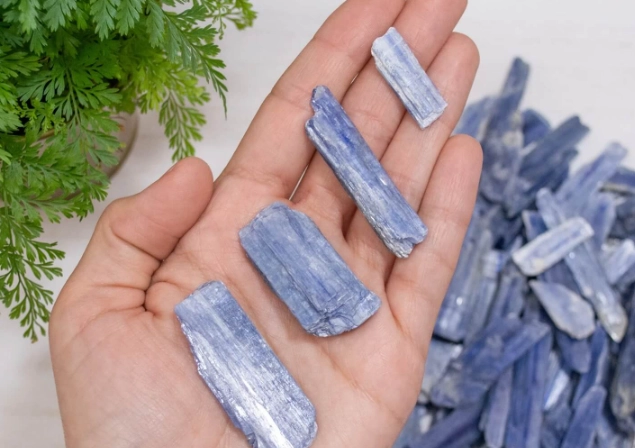
Is it a placebo? Maybe sometimes. But the ritual of holding a cool, smooth stone, focusing your intention, and taking a moment to breathe—that has real, tangible psychological benefits. The kyanite crystal becomes a tool for that mindfulness. I find the blue one genuinely calming. Maybe it's the color, maybe it's the association. It works.
The Other Life of Kyanite: Industrial and Practical Uses
This is the part most crystal blogs skip, and it's a shame. It's so cool. While we're buying tumbled stones, kyanite is out there doing heavy lifting in the real world. Its high heat resistance (it's a refractory material) and stability make it invaluable.
Crushed and processed kyanite is used in:
- Refractory Products: Lining for kilns, furnaces, and crucibles that must withstand temperatures over 1500°C. Your ceramic mug or steel car parts might have been made in a furnace lined with kyanite-based materials.
- Ceramics: Especially high-performance ceramics like spark plug insulators, bathroom fixtures, and electrical porcelains. It reduces shrinkage and warping during firing.
- Abrasives: Less common than some other minerals, but its variable hardness can be useful in certain grinding applications.
The main commercial producers aren't the spiritual hubs of Brazil or Nepal, but places like the United States (Virginia and Georgia have historically been major sources), India, and Kenya. The U.S. Geological Survey tracks kyanite production and use as an industrial mineral. It's a sobering reminder that this beautiful crystal is also a commodity. The gem and specimen quality is just a small, beautiful byproduct of a larger industrial operation.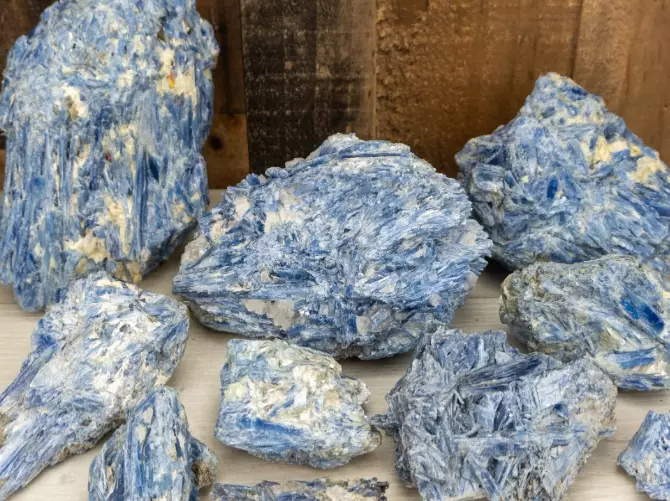
How to Buy Kyanite: A No-Nonsense Guide for Collectors and Users
So you want to get a piece of kyanite crystal. How do you make sure you're getting the real deal and not overpaying? Let's break it down.
Identifying Real vs. Fake Kyanite
Fakes aren't rampant, but they exist, especially for the deep blue, gemmy material. Here’s what to check:
- The Hardness Test: This is the big one. Find a discreet spot. Try to scratch it along the length of a blade with a steel nail (Mohs ~5.5). It should scratch relatively easily. Now try to scratch it across the blade. It should be much harder, resisting the nail. No other common blue stone does this.
- Temperature: Real stone feels cool to the touch and takes time to warm up. Glass or plastic feels warmer initially.
- Look at the Structure: Natural kyanite forms in long, flat, bladed crystals. They are often aggregated in parallel or radiating groups. If it's a perfect, smooth sphere or a carved shape with no visible grain or structure, it's likely been heavily worked or could be something else.
- Color Distribution: The blue color is often uneven—darker in the center of a blade, lighter on the edges, or streaky. Uniform, intense blue throughout can be a red flag.
Watch out for "Blue Quartz" or "Sodalite" being mis-sold as kyanite. Quartz is harder in all directions (Mohs 7). Sodalite is usually granular, not bladed, and lacks the hardness variation. A quick scratch test reveals all.
What to Look for Based on Your Purpose
Your goal changes what a "good" piece is.
- For Meditation/Energy Work: A raw or rough piece you can hold. Feel matters more than perfect looks. Look for a strong, intuitive connection. A palm-sized blade or cluster is great.
- For Jewelry: Tumbled beads are common and affordable. Faceted kyanite is rare and expensive due to its cleavage (it splits easily along planes). Bezel settings in rings or pendants are best to protect the stone. Check that the seller is reputable; the Gemological Institute of America (GIA) Gem Encyclopedia notes its sensitivity to knocks and pressure.
- For Collection/Display: Aesthetic is key. Look for specimens with good color, defined crystal forms, and an interesting matrix (the rock it's attached to). A label with the locality (e.g., "Loliondo, Tanzania") adds value.
Price varies wildly. A small tumbled stone might be a few dollars. A fine, deep-blue specimen from the Alps could be hundreds. Orange kyanite commands a premium due to its rarity. Black and green are often more affordable.
Caring for Your Kyanite Crystal
This is easy, because kyanite is famously low-maintenance. But it's not indestructible.
- Cleansing: The lore says it never needs it. Practically, rinsing it under lukewarm water or placing it on a bed of quartz is fine if you feel it needs a refresh. Avoid salt, which can be abrasive.
- Storage: Remember its variable hardness and perfect cleavage. Do not throw it loosely into a bag with harder crystals like quartz or topaz. It will get scratched and chipped. Wrap it separately or keep it in its own compartment in a fabric-lined box.
- Durability: Avoid ultrasonic cleaners, steam cleaning, and harsh chemicals. For jewelry, remove it before heavy physical work, gardening, or sports.
Kyanite Q&A: Answering Your Real Questions
Final Thoughts: The Stone of Alignment
Kyanite crystal is a bridge. It bridges the deep earth and the spiritual seeker. It bridges high-tech industry and ancient belief. That's its real magic. It's not the flashiest or most expensive crystal, but it has a quiet, assured presence.
Whether you're drawn to it for its geological wonder, its purported calming effects, or simply its serene beauty, it's a stone that rewards a closer look. Get a piece. Feel its cool, linear structure. Test its strange hardness. Use it as a focus point for your breath.
You might just find it helps align more than just your energy—it might align your appreciation for how complex and interconnected our natural world truly is. From the crushing pressures of mountain formation to the quiet of your meditation space, that's the journey of a single kyanite crystal. And I think that's pretty remarkable.
Related Articles
Larimar Stone Meaning: Healing, Spiritual Properties & How to Use

Tiger's Eye Stone: Ultimate Guide to Meaning, Benefits & How to Use
White Sapphire: A Real & Stunning Diamond Alternative
Lapis Lazuli Spiritual Meaning: Ancient Wisdom for Modern Life
Rhodonite: Meaning, Healing Properties & How to Use It Effectively