You just bought a beautiful Ocean Jasper sphere or palm stone. The swirling orbs and soft colors are mesmerizing. But a nagging thought creeps in: is this the real deal, or did I just get a pretty piece of dyed agate? Knowing how to tell if Ocean Jasper is real isn't just for collectors—it's essential for anyone who values authenticity in their crystals. Let's cut through the confusion. Real Ocean Jasper has a specific look and feel that fakes struggle to copy. This guide walks you through the exact tests and visual checks I've used for years to separate genuine material from convincing imitations.
What's Inside: Your Quick Navigation
- Why Telling Real from Fake Actually Matters
- The Visual Guide: Real vs. Fake Ocean Jasper Side-by-Side
- Hands-On Physical Tests You Can Do at Home
- How to Spot a Fake Before You Buy (Online & In-Person)
- The Usual Suspects: Most Common Ocean Jasper Fakes
- Going Deeper: Pro Tips from a Long-Time Collector
- Your Questions, Answered
Why Telling Real from Fake Actually Matters
It's not about being a snob. A fake stone is a hollow experience. You're drawn to Ocean Jasper for its unique energy, its connection to the earth, and its story of formation over millennia in Madagascar. A piece of dyed quartz or molded resin carries none of that. Practically, fake stones often involve harsh chemical dyes that can fade, crack, or even irritate your skin. If you're paying for a specific mineral, you should get that mineral. It's that simple.
Here's the thing most guides miss: The market is flooded with what I call "ethical fakes"—stones sold as Ocean Jasper that are actually a different, cheaper type of patterned jasper or agate. The seller might not even know it's not the real Madagascar material. Your job is to know the difference.
The Visual Guide: Real vs. Fake Ocean Jasper Side-by-Side
Your eyes are the first and best tool. Genuine Ocean Jasper has a signature appearance forged by its unique geology.
The Orbicular Patterns Are Key
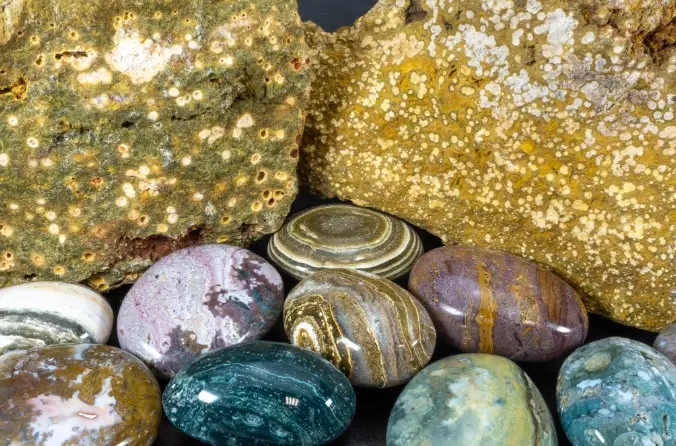
Real Ocean Jasper is defined by its "orbs" or circular patterns. These aren't perfect dots. They're more like nebulous, layered circles that sometimes connect or blend into a wavy matrix. The edges of these orbs are soft and blended, not sharp or painted-on. If the circles look too uniform, like someone stamped them with a cookie cutter, be suspicious.
Color Tells a Story
Authentic colors are earthy and soft: creamy whites, mossy greens, pale pinks, mustard yellows, and occasional rusty reds or browns. The colors reside within the stone, not on its surface. A huge red flag is neon or overly vibrant pink, blue, or purple. Ocean Jasper does not come in electric blue. The color distribution is also natural—it gradients, fades, and mixes within the orbs and matrix.
Texture and Finish
Polished genuine Ocean Jasper has a vitreous (glass-like) to waxy luster. It feels solid and cool to the touch immediately. The surface should have a natural depth. Some fakes, especially resin ones, feel suspiciously light, warm, or have a plastic-y, overly glossy shine that looks like a coating.
| Feature | Real Ocean Jasper | Common Fake/Imitation |
|---|---|---|
| Primary Patterns | Soft, blended, nebulous "orbs" or circular patterns. Often with banding or drusy centers. | Overly uniform dots, sharp lines, or patterns that look printed or painted on the surface. |
| Color Palette | Earthy, muted tones: cream, moss green, pale pink, mustard, soft brown. | Neon, artificially bright, or unnatural colors like electric blue, hot pink, or deep purple. |
| Color Distribution | Colors are integrated into the stone's structure, with natural gradients and blending. | Color sits in cracks or on the surface, often concentrated in crevices (a sign of dye). |
| Surface Feel (Polished) | Solid, substantial, cool to the touch. Lustre is vitreous to waxy. | Can feel lightweight, unusually warm, or have a high-gloss plastic-like shine. |
| Transparency | Mostly opaque. Thin slivers may show slight translucency at the edges. | Dyed agate fakes may be more translucent. Resin/plastic can be either completely opaque or oddly clear. |
Hands-On Physical Tests You Can Do at Home
Visual checks are great, but physical tests confirm your suspicions. Always be gentle, especially on polished pieces.
The Scratch Test (Hardness)
Ocean Jasper is a variety of quartz (chalcedony), with a Mohs hardness of around 6.5-7. This means it can scratch glass. Take a common glass bottle or jar and carefully try to scratch an inconspicuous part of it with your stone's edge. A real Ocean Jasper will leave a faint, permanent scratch on the glass. If your stone gets scratched or leaves no mark, it's likely softer material like calcite or resin. Don't use a knife for this test—steel is softer, so even real Jasper won't be scratched by it, which is misleading.
The Temperature Test
Minerals are good conductors of heat. Pick up your stone. It should feel noticeably cool to the touch and take a moment to warm up in your hand. Plastic and resin are insulators; they feel closer to room temperature or warm up almost instantly. This test is surprisingly reliable for spotting polymer clay or resin fakes.
The Light Test
Hold a bright flashlight (your phone's works) against the stone in a dark room. Genuine Ocean Jasper is mostly opaque, but you might see a faint glow or slight translucency around the very edges, or within thinner orbs. If light passes easily through large sections, it's probably a different, more translucent stone like agate that's been dyed. Total opacity is fine, but easy light transmission is a clue.
A word on the "water test": You'll see advice online to see if the stone floats or absorbs water. Ignore it. No real mineral will float, and testing absorption can damage porous stones or dyed fakes in ways you might not want. Stick to the safer methods above.
How to Spot a Fake Before You Buy (Online & In-Person)
Prevention is better than cure. Here’s how to vet a seller and a stone before money changes hands.
- Source Matters. Reputable sellers will state the origin. Phrases like "genuine Madagascar Ocean Jasper" or "from the Marovato quarry" are good signs. Vague terms like "patterned jasper" or just "Ocean Jasper" without provenance are yellow flags.
- Ask for Natural Light Photos. Sellers using only highly saturated, bright studio shots might be hiding something. Ask for a picture of the stone in natural daylight. This reveals true colors and surface details.
- Price is a Signal. Ocean Jasper is not the cheapest crystal. Large spheres, carvings, or specimens with rare colors command higher prices. If a deal seems too good to be true for a sizable, beautifully patterned piece, it probably is. You're likely looking at a different jasper or a manufactured item.
- Check Reviews Deeply. Don't just look at the star rating. Read reviews that mention authenticity, compare the received item to photos, and note any complaints about fading colors.
I once bought a "rare blue Ocean Jasper" tower online from a seller with great overall ratings. The photo was stunning. When it arrived, it was clearly dyed howlite—the dye was even rubbing off on the packaging. The seller's generic description was my first missed clue.
The Usual Suspects: Most Common Ocean Jasper Fakes
Knowing what you're up against helps. Here’s what’s usually passed off as Ocean Jasper.
1. Dyed Agate or Dyed Howlite: This is the most common. Agate has banding, not orbs. Howlite is porous and absorbs dye easily, often showing color concentration in its web-like cracks. The colors are usually garish.
2. Resin or Polymer Clay Imitations: These are molded and painted. They feel light, warm, and lack the crystalline heft. Under a magnifying glass, you might see bubbles, mold lines, or a lack of natural mineral grain.
3. Other Patterned Jaspers: This is the tricky one. Stones like Imperial Jasper, Kambaba Jasper, or even some types of Poppy Jasper have circular patterns. They're real minerals, but they're not Ocean Jasper. The difference is in the specific orb texture and the classic Ocean Jasper color combo. A reputable seller should label these correctly.
4. Glass: Less common, but glass can be swirled with colors. Glass is warmer, often has conchoidal fractures (sharp, shell-like breaks), and may contain air bubbles. Its hardness is similar, but the luster and internal structure are different.
Going Deeper: Pro Tips from a Long-Time Collector
After handling hundreds of pieces, you notice subtleties.
- The "Tongue Test" (Unofficial but Telling). If you're brave and the stone is yours, quickly touch it with the tip of your tongue. A real mineral will feel cool and stick slightly (like a cold, clean window). Plastic/resin feels... like nothing. Just room temperature. It's unorthodox, but it works.
- Invest in a Cheap Jeweler's Loupe. A 10x magnifier reveals a world of detail. Real stone shows crystalline structures, tiny mineral inclusions, and natural pits. Dyed stone shows dye concentrated in cracks. Resin shows bubbles and a uniform, non-granular texture.
- Weight and Density. Get a feel for it. A real palm-sized sphere has a certain satisfying heft. A resin copy feels like a hollow toy. Compare it to a known piece of quartz of similar size—they should feel similarly dense.
- When in Doubt, Seek Community. Post clear, natural-light photos in dedicated mineral identification forums on Reddit (like r/whatsthisrock) or Facebook groups. Experienced collectors can often spot an imitation from a mile away.
Your Questions, Answered
Related Articles
Ocean Jasper Guide: Meaning, Properties, and How to Identify Real Stones
Labradorite Crystal Meaning: Healing, Magic & Practical Uses
Azurite Mineral Guide: Properties, Value & How to Identify Genuine Stones
Green Jasper Benefits: Healing Properties and Practical Uses
Unveiling Green Onyx Properties: A Deep Dive into Its Meaning, Uses & Care